Review Cards for Customers: Why Your Competitors Have More Google Reviews Than You
You may have seen it before.
Two businesses offer a similar service. Their customers seem equally satisfied. Their pricing is comparable. Their quality is comparable.
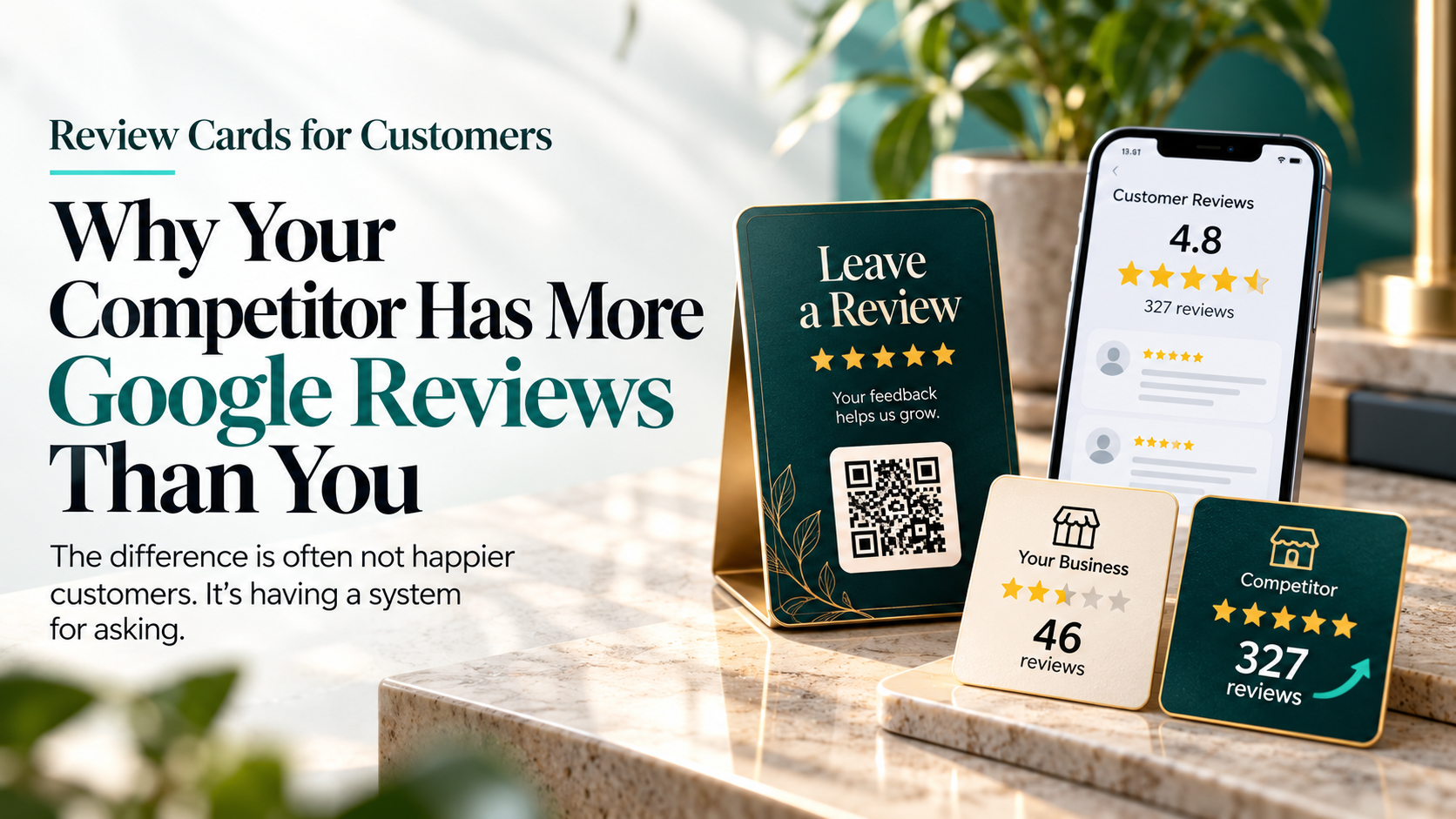
But one business has 327 Google reviews.
The other has 46.
It’s easy to assume the first business must simply be better.
Sometimes that’s true.
But often, the difference is much simpler:
One business has a system for collecting reviews. The other one waits and hopes.
That distinction matters because reviews usually do not happen automatically, even when customers are happy.
A customer can leave your restaurant satisfied, love the haircut they just received, feel relieved that their repair was completed properly, or be genuinely impressed by your service — and still never write a review.
Not because they had a bad experience.
Because life moves on.
That is why review collection is less about persuasion and more about process.
And that is where review cards for customers become useful.
Happy Customers Still Forget
Business owners often think:
“If people are happy, they’ll leave a review.”
Some will.
Most won’t.
The problem is rarely intent. It is usually friction.
The customer walks out the door.
They get into their car.
They check a message.
They start thinking about dinner.
Later that evening, they vaguely remember that they meant to leave you a review.
Then tomorrow arrives.
The moment is gone.
Even customers who genuinely want to support your business may have to:
- remember your exact business name
- search for you on Google
- make sure they found the correct listing
- navigate to the reviews section
- click the right button
- decide what to write
None of those steps is especially difficult.
Together, however, they create enough friction for the task to be postponed.
And postponed tasks tend to disappear.
Your Competitor May Simply Be Asking Better
If your competitor has more reviews, they may not have happier customers.
They may simply be better at creating a review moment.
That usually means three things:
- They ask at the right time
- They make the request visible
- They make the next step easy
That is the entire system.
It does not require complicated software.
It does not require chasing every customer three days later.
It simply requires creating a consistent path from:
satisfied customer
to
review request
to
review page
Businesses that do this repeatedly accumulate reviews.
Businesses that do not are depending on customer memory.
Customer memory is not a particularly impressive marketing strategy.
What Review Cards for Customers Actually Do
A review card does something very simple:
It turns an invisible request into a visible one.
Instead of saying:
“Maybe leave us a Google review sometime.”
you give the customer something physical to see or scan.
That could be:
- a small card handed over after a service
- a card inside a restaurant bill holder
- a QR card at reception
- a small insert inside packaging
- a countertop sign near checkout
- a card included in a takeaway bag
The card itself is not the strategy.
The strategy is placing the request at the right moment.
The card simply makes that system easier to repeat.
Google Review Request Cards Reduce the Friction
This is where Google review request cards with QR codes become especially useful.
Without a direct link, the customer has to find you.
With a QR code, they can simply scan.
The journey becomes:
See the request → scan → open the review page → leave feedback.
That is a much shorter path.
And shorter paths matter.
Every additional step creates another opportunity for someone to stop.
That principle is true in checkout flows, lead forms, booking systems, and review requests.
The easier the action, the more likely people are to complete it.
Timing Matters More Than Most Businesses Realize
A review request is usually strongest when the customer is still emotionally connected to the experience.
For example:
Restaurants
A diner has just finished a good meal.
That is a better moment to present a review card than sending a vague request days later.
A small card inside the bill holder or near the payment terminal can create a natural opportunity.
Salons and beauty businesses
The customer has just seen the finished result.
That is a strong satisfaction moment.
A QR review card at reception can make the next step obvious.
Home-service businesses
The repair is finished.
The customer has inspected the work.
The problem is solved.
That is the moment when a small review card can make sense.
Retail businesses
A review request can appear at checkout or inside the packaging.
Clinics and professional services
The request can be placed at reception or included with appropriate post-visit materials.
The exact moment varies.
The principle does not.
Ask when the experience is still fresh.
The Best Review Request Does Not Feel Like Begging
There is another reason review cards can work well.
They can make the request feel less awkward.
Compare these two experiences.
A staff member says:
“Can you please leave us a five-star review?”
That can feel pushy.
Now compare it with a small, well-designed card that says:
“Thank you for choosing us. We’d love your feedback.”
with a QR code underneath.
That feels different.
It feels more like part of the customer experience.
Less pressure.
More invitation.
That matters because good review requests should make feedback easy without telling customers what they are supposed to say.
The best wording is usually simple:
- “Scan to review us on Google.”
- “We’d love your feedback.”
- “Tell us how we did.”
- “Thank you for choosing us.”
The goal is not to manufacture praise.
The goal is to remove friction for people who already want to share their experience.
Consistency Is the Real Advantage
This is the part many businesses underestimate.
A review system does not need to be brilliant.
It needs to be consistent.
Imagine two businesses.
Business A asks for a review once in a while.
Business B has a review card at checkout every day.
Business A depends on staff remembering.
Business B built the request into the process.
Over six months, the difference compounds.
Not because Business B discovered some secret growth hack.
Because they repeat the same small action hundreds of times.
That is how review counts accumulate.
The competitive advantage is often boring.
And boring systems are usually much more useful than exciting intentions.
Build a Simple Review System
If you want more reviews consistently, keep the process simple.
1. Choose the moment
Decide when the customer is most likely to feel satisfied and receptive.
After the meal?
After the service?
At checkout?
At the handoff?
2. Choose the request
Keep the wording short and neutral.
Do not overload the card with several messages.
3. Create a direct destination
Use a QR code or direct review link that takes customers to the correct Google review page.
4. Put the request where customers naturally pause
Do not hide the card somewhere decorative but invisible.
Placement matters.
5. Repeat
This is the part that actually creates the system.
Every day.
Every customer.
Same process.
Over time, that consistency can create a very different review profile.
What Makes a Good Review Card?
A review card does not need to be complicated.
It should be:
- easy to understand
- easy to scan
- easy to recognize as part of your business
- visually clean
- correctly linked
- placed where customers can actually see it
A good QR code should have enough contrast and space around it to scan reliably.
The call to action should be obvious.
And the design should not look like a random generic template that has nothing to do with your business.
That is where a professional review card can make the request feel more intentional.
DIY Template or Finished Card?
If you want to use review cards for customers, there are several ways to create them.
You can make the entire thing yourself.
You can buy an editable Canva template.
Or you can use a done-for-you service where the card is customized for your business and delivered ready to use.
The difference is simple.
A template gives you something to finish.
A done-for-you card gives you the finished asset.
For some business owners, editing the design and creating the QR code is no problem.
For others, it is just another small task that never quite gets done.
And if the goal is consistency, the best system is usually the one you will actually use.
If Your Competitor Has More Reviews, Look at the System
Instead of assuming your competitors have better customers, better luck, or dramatically better service, look at what they do after the customer experience.
Do they ask?
Do they have a QR code visible?
Do they display review request cards?
Do staff mention feedback consistently?
Do they make the next step easy?
That is often where the difference lives.
Reviews are not just a reflection of customer satisfaction.
They are also a reflection of how easy the business makes it for customers to speak up.
Want the Review Card Without the DIY Work?
Disclosure: I sell the digital review cards mentioned below.
If you want to build a simple review system without editing Canva templates or setting up QR codes yourself, I offer Digital Google Review Cards with QR Code personalized for individual businesses.
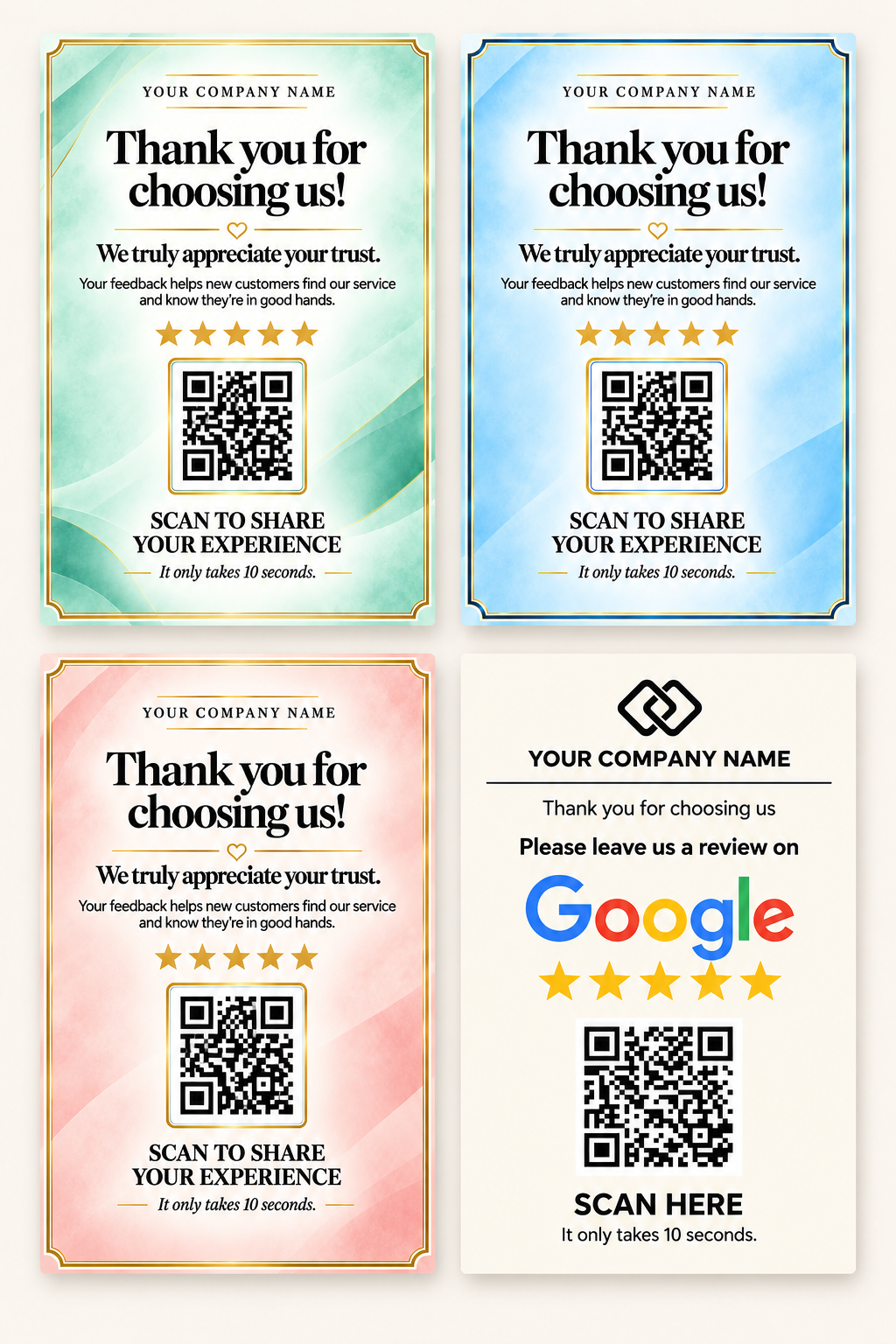
You provide your business details and Google review destination, and the finished card is customized for you.
No Canva editing. No NFC hardware. No QR-code setup.
Just a finished digital review card you can print and start using with customers.